Monday, August 25, 2014

New Zealand Saison and Glycosides

Decoction bubbling in a three gallon clad stock pot.Terroir is a fascinating thing. New Zealand white wines (chiefly Sauvignon Blanc) have gained worldwide attention for exhibiting exciting flavors and aromas (e.g., lime-zest and gooseberry) not produced when the same grapes are grown in Europe or the Americas. It is intriguing that New Zealand grown hops like Motueka (originally called Belgian Saaz) and Nelson Sauvin (related to Cluster by way of Smoothcone) have gained popularity for aromatics described with many of the same terms!

While shopping for beer a few months ago, I tried a sample of Fernlands Sauvignon Blanc 2013 (from Marlborough, NZ). The idea immediately struck me to add the wine's citrusy flavors to a hoppy/tart/funky saison. In addition to a yeast blend harvested from ‘Merican Saison, I pitched Wyeast’s Lactobacillus brevis. Given the heightened IBUs I wasn’t expecting sharp acidity, but I wanted some tartness to enhance the grapefruit and lime.

Blending a sample of the saison with a small amount of New Zealand Sauvignon BlancThis was far from my first time combining wine to beer, for example a variant of my first Pizza Port Mo’ Betta Bretta clone was mixed with cherries rehydrated in Pinot Noir, a Russian River Temptation clone with Chardonnay, and my trials blending Oud Beersel Gueuze with Maison Trimbach Riesling. The quality of wine you can procure is usually better than the wine grapes you can source locally, and if nothing else combining them is a much simpler task. Mixing wine into a batch of commercial beer isn’t allowed (which is why breweries tend to turn to wine barrels and grapes); you have to appreciate the legal freedom homebrewing allows! When the base saison was finished dry hopping, I blended a sample with measured amounts of the wine for evaluation. I could have stood for adding more than 750 mL (~4.3% of the batch) of wine to the keg, I should have bought two bottles!

Some Brett strains are capable of freeing aromatic aglycones found in hops, fruit, and spices which are attached to sugars in molecules called glycosides. I have a few mentions of this in American Sour Beers, but the section about hop glycosides was dropped because more comprehensive/specific research is underway:

Certain strains of Brettanomyces (those that produce the enzyme β-glucosidase) have the ability to release aromatic aglycone compounds by splitting the glycosides provided by hops. Very few Saccharomyces strains can release aglycone, and those that do at a much lower rate than Brettanomyces.1
The amount of glycosides in hops varies widely by varietal, but the only extensive research into the actual amounts is the proprietary information contained in studies by Miller Brewing. Miller Brewing treated an extraction of hops with β-glucosidase and subsequently used a gas chromatograph to detect “benzaldehyde (almond, maraschino cherry), vanillin (vanilla), raspberry ketone, geraniol (floral, rose), linalool (floral), phenylacetaldehyde (honey, floral), and many other primary alcohols, ketones, and aldehydes which are also aromatic.”2 Methyl salicylate (wintergreen, minty, spicy) is another aglycone which has been shown to be released by the enzymatic action of Brett.3
Citations:
1. Luk Daenen, Daan Saison, Femke Sterckx, Freddy R. Delvaux, Hubert Verachtert and Guy Derdelinckx, “Screening and evaluation of the glucoside hydrolase activity in Saccharomyces and Brettanomyces brewing yeasts.”
2. Beer Sensory Science “Glycosides:The Hidden Flavors.”
3. Luk Daenen, “Use of beta-glucosidase activity for flavour enhancement in specialty beers.”

The New Zealand saison is keg conditioning to boost the Brett activity without extended aging that might compromise the vibrant hop aroma. The second runnings from it were turned into a Berliner weisse that will be receiving some citrus, most likely lemon, eventually. More on that batch later!

New Zealan' Saison

Recipe Specifics
--------------------
Batch Size (Gal): 5.00   
Total Grain (Lbs): 16.50
Anticipated OG: 1.062   
Anticipated SRM: 2.4
Anticipated IBU: 37.7
Brewhouse Efficiency: 77 % (w/ parti-gyle)
Wort Boil Time: 75 Minutes

Grain
-------
 66.7% - 11.00 lbs. Rahr Pilsener
 33.3% - 5.50 lbs. Wheat Malt  

Hops
-------
1.38 oz. Czech Saaz (Pellet, 2.70% AA) @ Mash Hop
1.00 oz. Rakau (Pellet, 11.00% AA) @ 30 min.
2.00 oz. Motueka (Pellet, 12.00% AA) @ 0 min.
2.00 oz. Nelson Sauvin (Pellet, 12.00% AA) @ 0 min.
2.00 oz. Motueka (Pellet, 12.00% AA) @ Dry Hop
2.00 oz. Nelson Sauvin (Pellet, 12.00% AA) @ Dry Hop

Extras
--------
0.50 Whirlfloc @ 15 min.
0.50 tsp Yeast Nutrient @ 15 min.

Yeast
-------
The Yeast Bay Saison Blend
White Labs WLP644 Brettanomyces bruxellensis var. Trois
Brettanomyces bruxellensis var. CB2 (Jason Rodriguez isolate)
Wyeast L5223-PC Lactobacillus brevis

Water Profile
-----------------
Profile: Washington, DC

Mash Schedule
------------------
Sacch I - 90 min @ 148 F   
Sacch II - 15 min @ 155 F (decoction)

Notes
-------
7/26/14 Made a 1L starter (50 g DME, Wyeast nutrient, chilled to 112F, put on stir-plate on low) with Wyeast L. brevis (two weeks from manufacture).  Strong activity by the next morning, already a bit tart. "Some even benefit, for example L. brevis yields 50% more cells when aerated." - ASB

Brewed 7/27/14

Added 3 g of CaCl and 1 tsp of 10% phosphoric acid to the mash (along with a couple handfuls of rice hulls. Same treatment for the 170 F sparge water.

Parti-gyle batch sparge.

Swapped wort back and forth to achieve 7.25 gallons @ 1.052, and 5.5 gallons at 1.034.

New Zealand Saison with first runnings - L. brevis, and saison/Brett blend from keg, loads of NZ hops, New Zealand Sauv Blanc. Pre-dilution OG = 1.070. Added 0 min hops and allowed to steep for 20 minutes before chilling. 8 g of 88% lactic acid. Added 1/2 gallon of distilled water (cold) to help it chill the rest of the way at the same time as the keg dregs (~6 hours after pitching the Lacto). Left at 65F to ferment

Lemon Berliner - Brought just to a boil, added yeast nutrient, chilled to 85F, pitched Lacto, added 7.5 g of 88% lactic acid (aiming for 4.5 pH), left at 65F to ferment. OG 1.030. L. brevis and Saison Brett dregs for the first 24 hours - activity by 12 hours, then US-05 (11 g, not rehydrated) (down to 1.024 at that point).

7/30/14 Both batches moved to ~75F ambient after three days to ensure complete fermentation.

8/7/14 Dry hopped saison portion.

8/17/14  Kegged the saison (1.008, 87% AA, 7.1% ABV. Light acidity, nice hop aroma) with ~750 ml of Fernlands 2013 Sauvignon Blanc and 3.5 oz of table sugar. Flushed keg twice before and after filling. Left at ambient basement to condition for a couple weeks before tapping. 7.3% ABV including the wine.

10/29/14 Tasting notes. Not much I'd change, delicious blend of citrus and funk, from the hops, wine, and Brett.

Wednesday, August 20, 2014

Blonde Ale on Coffee Beans Recipe

Modern Times Black House - Nitrogenated!There are many tropes in brewing. Ingredient and flavor combinations that brewers often select because of their reliability. Pale/dry/hoppy, sour/cherry, and maybe most prominently dark/coffee. I’d wager that 98% of coffee beers are located somewhere on the porter-stout continuum. There is nothing wrong with that; roasted malts and grains help to enhance the coffee character in the appearance, flavor, and aroma. Heck I helped design Black House for Modern Times (which I finally got to drink at the brewery on nitro last week, what a revelation!). There are a few breweries that have experimented with adding coffee to other beer styles; two I’ve enjoyed are Mikkeller Koppi IPA and Stone’s collaborative Dayman Coffee IPA. The combination of citrusy coffee with citrusy hops works surprisingly well in both!

I wanted to borrow that basic concept, with Cascade and Ceremony Thesis Blend in my case, but produce a beer where the hops accentuate the coffee (rather than the other way around). My goal was not to brew a “blonde stout” which I regard as a gimmick (although I'm told it can be a very tasty gimmick). The base beer for my batch is an American Blonde, with a touch of Golden Naked Oats for body, and a pinch of crystal 60 for caramel.

Over the weekend I coincidentally had the opportunity to try Hill Farmstead Walden for the first time (thanks to my friend and kickass homebrewer Sean Gugger). It was remarkable, like so many of their beers, especially that mouthfeel for a 3.9% ABV blonde ale (thanks in part to the 1.014 FG we measured).

Ceremony is a roaster in Annapolis, MD that does a variety of interesting coffees. Thesis Blend was a big help many weekend morning (and afternoons) as I churned away on American Sour Beers. Audrey is a big fan as well. They describe it as possessing: "Cocoa butter and raisin aromatics. Muscovado sugar and tobacco with clementine acidity in a balanced cup." I always suggest brewing with coffee you like to drink. For a similar recipe I’d opt for a light to medium roast, something with bright flavors to mesh with the grapefruity hops.

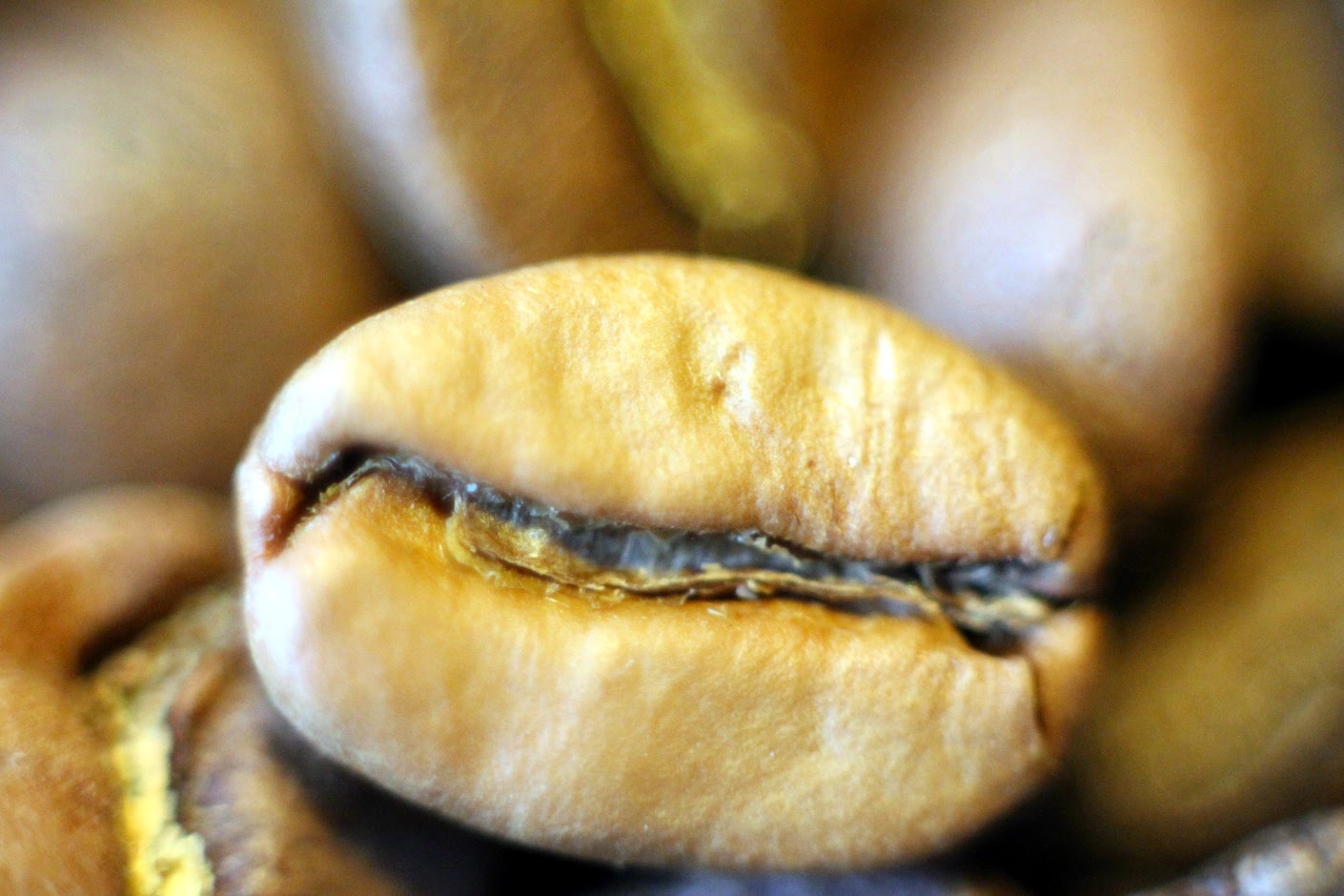
A very pale coffee bean, a quaker it appears.As an interesting side note, apparently one often overlooked aspect of coffee quality is quakers. These underdeveloped beans are identified by their paler color post-roast and peanut-like flavor. Apparently "according to Steven Diaz, quality director at Expocafe S.A in Colombia, 'just one quaker bean among the beans that go into one cup can affect the flavor dramatically.'" I only spotted one for removal in the two ounces destined for the beer.

As with my usual process for coffee beers, I added whole beans loose to the fermentor (without sanitizing them). We pulled a sample after 28 hours, and it already had enough coffee to proceeded with kegging. It’s amazing how much character comes through thanks to the extraction by both alcohol and water. I also find that this technique produces a longer-lasting coffee aroma compared to cold brewing in water alone, although that likely won’t matter too much for this batch.

This coffee blonde has been on CO2 for a few days already, still waiting for a spot on tap to become available. I may add a small dry hop addition depending on how it tastes cold and carbonated.

Spent coffee beans after 24 hours soaking in beer.Blonde Coffee Blonde

Recipe Specifics
-------------------
Batch Size (Gal): 5.25
Total Grain (Lbs): 9.75
Anticipated OG: 1.044
Anticipated SRM: 5.3
Anticipated IBU: 27.6
Brewhouse Efficiency: 64 %
Wort Boil Time: 75 Minutes

Grain
-------
46.2% - 4.50 lbs. Rahr Pilsener 
23.1% - 2.25 lbs. MFB Pale Ale Malt
23.1% - 2.25 lbs. Great Western Pale Malt
5.1% - 0.50 lbs. Golden Naked Oats
2.6% - 0.25 lbs. Briess Crystal 60L

Hops
------
1.00 oz. Cascade (Whole, 6.20% AA) @ 20 min.
1.00 oz. Cascade (Whole, 6.20% AA) @ 10 min.
1.00 oz. Cascade (Whole, 6.20% AA) @ 5 min.
1.00 oz. Cascade (Whole, 6.20% AA) @ 0 min.

Extras
--------
0.50 tsp Yeast Nutrient @ 15 min.
0.50 Whirlfloc @ 15 min.
2.00 oz Thesis Blend Coffee Beans - 1 day

Yeast
------
SafAle S-04 English Ale

Water Profile
----------------
Profile: Washington, DC

Mash Schedule
-----------------
Sacch Rest - 45 min @ 155F

Notes
-------
Brewed 8/3/14 with Audrey

2 g CaCl added to the mash and sparge. 1 tsp of phosphoric acid added to the mash. Batch sparge with 175F water with 1 tsp of phosphoric acid. Collected a total of 7 gallons of 1.038 runnings.

Adjusted hops alpha acid down from 7.3%, from Freshops 2013 harvest.

Let sit with 0 min hops for 10 minutes before chilling. Chilled to 65F with water then recirculated ice, topped off with 2/3 of a gallon of spring water, shook to aerate, sprinkled yeast on the surface, left at 65 F ambient to ferment.

8/17/14 Added 2 oz of whole bean Thesis Blend from Ceremony. Picked through to remove "quakers" and  small beans.

8/18/14 Kegged. Plenty of coffee flavor already. Put in kegerator on gas to carbonate while waiting for a tap to open up.

10/6/14 Tasting notes, nice blend of hops and coffee. Hop aroma could have been slightly more intense (from say one ounce of dry hops) and the malt bill could have been reduced to just Pils and wheat to get out of the way and ensure a paler color.

Tuesday, August 5, 2014

American Sour Beers Book Tour!

Keeping checking back to this post for the latest on where I'll speaking and signing copies of American Sour Beers!

2017:

February 24-25 in Santa Rosa, CA - BYO Boot Camps

March 25-26 in Nelson, NZ - New Zealand Home-brewers' Conference

April 11 in Washington, DC - Craft Brewers Conference (Book Signing at 11 AM)

November 4-5 in Santa Rosa, CA - BYO Boot Camps

Photo (c) Brewers Association

2014:

August 10 in San Diego, CA - Sour tasting and presentation at Modern Times (Sold Out)

August 14 in San Diego, CA - Book Signing at Modern Times

September 4 in Boston, MA - Book Signing at Trillium Brewing

September 13 in Elmsford, NY - Book Signing during Sour'd in September at Captain Lawrence Brewing

October 2-4 in Denver, CO - Book Signing at Great American Beer Festival
 
October 18 in Houston, TX - Presentation at Dixie Cup

November 8 in Ashburn, VA - Presentation during MBAA meeting at Lost Rhino

November 22 in Washington, DC - DC Craft Beer Festival

2015:

March 28 in New York, NY - Bitters and Esters @ 4 PM

March 29 in Massapequa Park, NY - Long Island Beer and Malt Enthusiasts @ 9 AM

May 1-2 in Florianopolis, Brazil - I Congresso Técnico para Cervejeiros Caseiros

June 11-13 in San Diego, CA - 2015 National Homebrewers Conference

August 10 in Washington, DC - 3 Stars Brewing Co. from 6-8 PM

October 31 in Fargo, ND - Hoppy Halloween

2016:
 
March 5 in San Diego, CA - Festival of Funk

April 23 in Drammen, Norway - Hjemmebryggerhelgen 2016

June 11 in Baltimore, MD - HomebrewCon

June 25 in Lansdowne, VA - Brew LoCo

August 13 in Asheville, NC - Asheville Homebrewers Conference

September 3 in Virginia Beach, VA - Commonwealth Brewing Co's First Anniversary Party and Collaborative Oud Bruin Release

November 4-5 in Burlington, VT - BYO Boot Camps

Wednesday, July 30, 2014

Solera Pull No. 2 - Straight and on Flowers

One of the great skills of the lambic brewers and gueuze blenders is identifying which barrels are best blended, fruited, dry hopped, saved, or served straight. It isn’t that the “best” beer is used for one application and the second best for another, they’ve learned what flavor work best for each application (or specific fruit). Instead of deciding on brew day what ingredients you’ll add to a batch of sour beer, try drinking a sample and imaging what flavors might enhance its positives and conceal its flaws (if either is required).

Here is a tasting of two versions of the second pull from the wine barrel solera in my basement!

Tasting the second pull from the solera Nathan and I started back in 2010!Solera Pull #2

Appearance – Slightly cloudy, appears to be yeast particulate (clearly I didn’t stop the pour early enough). Vibrant golden-yellow body. The white head is unremarkable, sinking to a thin ring after a few minutes of inspection.

Smell – Despite an additional pitch of Wyeast B. bruxellensis this wine barrel has consistently produced beers been less funky than most of my batches. It shares many similarities with Petrus Aged Pale rather than a lambic or gueuze. The vinous barrel shows through nicely, really the star of the aroma.

Taste – The flavor starts and ends with bright acidity. Very lactic, and firm while sidestepping harshness. There is a rounded malt flavor that compliments and even balances the acidity successfully. Fruity, faint Granny Smith? There just isn’t as much character here as I’d expect from the second pull from a solera fermented with ECY Bugfarm, I need some funky, earthy, citrusy something!

Mouthfeel – It has a medium-light body with moderate carbonation. Not light and spritzy enough for a lambic, which further enhances the Flemish-pale vibe.

Drinkability & Notes – A solid beer, but I think this one excels as a base for other flavors (with fruity dry hops for example it was transformed into one of my favorite beers). It doesn’t have the complexity that a sour needs to stand on its own. It’s probably passed time for another pull, or a decision that the solera has run its course.

While brewing the classics is always fun, I think most homebrewers enjoy venturing off the well-trod path occasionally. When Nathan (now a "savant" according to the WaPost) and I started our two soleras a few years ago we decided to use it to experiment with some of the more interesting concepts we could come up with: roasted butternut squash, cinnamon, and nutmeg; infused with elderflowers; aged on Cabernet Sauvignon wine grapes etc.

This is the same beer as above, but this five gallon portion was aged on one ounce each of dried chrysanthemums and jasmine flowers. We racked out of the barrel in May, 2013 into a carboy with the flowers and bottled a few weeks later.

Flora Solera

Gorgeous pour of the solera aged on chrysanthemums and jasmine flowers!Appearance – A bit more careful on the pour on this one and it has a stunningly clear golden body (thank you protein-munching bacteria). Head retention is actually pretty good for a sour beer, better than the plain portion.

Smell – While it might look like a lager, it certainly doesn’t smell like it. The mums lead with their weird-floral-herbaceous character. I don’t pick out the jasmine distinctly, but I suspect it is keeping the beer more towards the floral than the herbal. Relatively straight ahead sour beer behind that, it projects a touch of acetic/vinegar.

Taste – Big acidity leads. No vinegar, but loads of lactic. The result is a firm acidity, but none of the sharpness I get in the finish from vinegary beers. The jasmine adds a juiciness to the mid-palate, while the mums contribute an interesting almost toasty finish. The flowers combined to add some interest to the relatively bland base.

Mouthfeel – Medium-light body, works well with the slightly elevated alcohol. Firm carbonation, but nothing disruptive.

Drinkability & Notes – Intriguing, but not likely an experiment I’d repeat. The jasmine and mums don’t blend harmoniously with the base beer, they stick out too much. So many interesting flowers available, this likely won’t be the last time Nathan and I brew something “weird” like this!

Tuesday, July 15, 2014

Priming Barrel-Aged and Blended Sour Beers

In the Packaging chapter of American Sour Beers I included formulas designed to estimate the amount of carbonation that will be produced by the microbes when blending similar sour beers of different gravities. While I believe it is important to understand the logic behind the math, it is certainly much easier to simply plug in the numbers rather than solve equations by hand. A few weeks ago someone emailed a question about the formulas, which sparked me to put together an easier method. I finally found time to refine it, so here I present my Blending Priming Calculator spreadsheet! Unlike the formulas in the book, it can determine carbonation for a blend of up to five beers.

These formulas are only exact if the wort for each component is identical. Having the same carbohydrate profile ensures that the remaining dextrins in one batch would be fermentable by the bacteria and Brettanomyces present in another. You’d expect the final gravity of the blend to approach the final gravity of the driest component, which is why this component must be entered in a specific position in the spreadsheet. Even then there is no way to guarantee the accuracy of the calculation because more attenuative microbes could be "hiding" in a younger/sweeter component.

To use the spreadsheet, start by selecting the number of component beers you will be blending from the drop-down list. This selection controls which formulas are used from the hidden Calculations tab.


Input the peak temperature the beer reached after the gravity stabilized (this is the same as all other priming calculators). If you ferment a beer through a warm summer and it continues to ferment into the fall, but stops before winter, you’d note the temperature it was when you stopped seeing the gravity drop (assuming it didn't get warmer after that). If the beer fermented all winter, but aged into the hot summer, you'd note the hottest temperature it reached during the summer.

I’ve noticed anecdotally that long-term aging in a barrel knocks about half of the assumed residual carbonation out of the beer. The "Residual CO2 Volumes" in red will calculate automatically. If you happen to own a capable CO2 meter (aren't you lucky!), you could override these calculation and simply enter the measured volumes of CO2 in row 5.


At this point enter the current gravity reading for each component and the volumes of beer that you plan to include in the blend. With those pieces of information entered you can see how much residual carbonation the blend will contain at bottling, and after it completes bottle-fermentation (assuming no priming sugar).


Input the target volumes of CO2 desired, and the formulas will display how much table or corn sugar would be required to carbonate the beer to that level. As we are assuming the fermentation of dextrins from the blended beers, it may take 6-12 months of cellaring to achieve full carbonation (as is carried out by traditional Belgian gueuze blenders).


I’ll certainly update this spreadsheet as I think of improvements (and hear your suggestions). At a minimum I'll add a metric tab as the metric formulas are already presented in the book.

Check out the updated/enhanced version of this spreadsheet from Jeffrey Crane of Council Brewing: http://jeffreycrane.blogspot.com/2015/06/blending-calculator-ph-abv-and.html

Tuesday, July 8, 2014

Saison 'Merican - Hoppy Funk

Spent hops left in the kettle after this saison.Brewing with newly developed/discovered ingredients is a necessity if you want to keep up. Sometimes I envy the people brewing 15 or 20 years ago when you knew what malts, hops, and yeasts were going to be available. These days it seems like every year there are 15 new yeast strains, 10 malts, and 5 hops. Then you find a great ingredient, but all of a sudden it's impossible to get your hands on again (looking at you Wyeast Brettanomyces anomalus, Golden Naked Oats, and Riwaka). Is it really practical (or even worthwhile) to brew with every new release under experimental conditions?

As much fun as I’ve had with split batch experiments to tease out the contributions of various sugars, hops, Brett strains, etc., in the end I’m not sure how well stripped down recipes answer the question of how to maximize an ingredient. Does using a crystal malt as the lone specialty grain in a low hopped beer really give you an accurate idea of what it will add to a hoppy porter? More than simply tasting and smelling the malt itself? Rather than trial The Yeast Bay’s Saison Blend in a bare-bones classic Dupont-style recipe, I opted to take their “grapefruit and orange zest” description to heart and load up on bold hops! The aroma blend (2:1:1 Mosaic, Citra, and Nelson Sauvin) was cribbed from the dry hopped solera that Nathan and I bottled last year (which skewed deliciously peachy).

This is the fuzzy looking rye malt, I tossed the last pound.The concept for this batch was heavily influenced by the hoppy-funky saisons that Prairie Artisan Ales has released (e.g., Hop, ‘Merica, Potlatch). Basic Brewing Radio has an excellent interview with their founder/brewer Chase Healey (James shipped me a couple bottles of their beer as well). I was surprised to find out Prairie dry hops as if they were IPAs and then pitches Brett at bottling with the beer already below 1P (1.004). I decided to do something similar, by keg-conditioning on the dry hops. I find that Brett produces an assertive character much more rapidly under pressure (key when you are looking to drink a beer like this while the hops are still fresh).

The rye malt from a previous batch, looks much more normal, no fuzz.The only unexpected variable was the Thomas Fawcett rye malt (freshly delivered from Rebel Brewer). My first whiff was a bit musty, but not in a bad way. It wasn’t until after brewing that I took a closer look at the remaining pound and noticed a dusty coating (compare to say the rye malt in my Whiskey Barrel Rye Stout). Luckily the beer tastes fine, and I haven't started hallucinating....

Saison ‘Merican Tasting

A glass of saison on a sunny afternoon, pretty sight!Appearance – The beer itself is not too far from orange juice (extra pulp). Hazy, but with a luminous quality. The head is billowy, sticky, and very bright white. Looks like a cross between an IPA and a rustic saison, no complaints here.

Smell – One of those magic sorts of smells with aromatics coming from the hops, saison yeast, Brettanomyces, and malt to form a unified wave of citrus, mango, and funk. Bold and inviting. The divisive Nelson “stink” starts to poke through as the beer warms.

Taste – The hops play lead despite being off them for more than a month, with loads of juicy tropical fruit. They dissolve into the funkier aspects in the finish (nothing too aggressive, more towards hay than horse stall). The saison yeast plays a supporting role with mild pepper. Much more citrusy than then blend in the solera, which I attribute to the yeast as well. Dry, but not bone dry thanks to the Golden Naked Oats. Moderate bitterness lingers for a moment, leaving me with the need for another sip.

Mouthfeel – Medium-light body, with medium-high carbonation. I was aiming slightly fuller than the classic saison to support the elevated hopping rate, and it works well.

Drinkability & Notes – An unequivocal success! One of the best saisons I've brewed (or tasted). This is exactly the sort of beer I love to drink, so much going on in such a neat little package. Not the sort of funk-bomb you need to struggle through, but enough to let you know it’s not a "Belgian IPA." I'll certainly be brewing this one again before too long.

Saison 'Merican Recipe

Recipe Specifics
-------------------
Batch Size (Gal): 5.50
Total Grain (Lbs): 10.75
Anticipated OG: 1.054
Anticipated SRM: 4.2
Anticipated IBU: 37.1
Brewhouse Efficiency: 77 %
Wort Boil Time: 90 Minutes

Grain
-------
74.4% - 8.00 lbs. Weyermann Bohemian Pils
18.6% - 2.00 lbs. Thomas Fawcett Rye Malt
4.7% - 0.50 lbs. Simpsons Golden Naked Oats
2.3% - 0.25 lbs. Weyermann Acidulated

Hops
------
0.75 oz. Columbus (Pellet, 13.30% AA) @ 60 min.
2.00 oz. Mosaic (Whole, 10.00% AA) @ 0 min.
1.00 oz. Citra (Whole, 10.00% AA) @ 0 min.
1.00 oz. Nelson Sauvin (Pellet, 12.00% AA) @ 0 min.
2.00 oz. Mosaic (Whole, 10.00% AA) Dry Hop
1.00 oz. Citra Whole (Whole, 10.00% AA) @ Dry Hop
1.00 oz. Nelson Sauvin (Pellet, 12.00% AA) @ Dry Hop

Extras
--------
0.50 tsp Yeast Nutrient @ 15 min.
0.50 Whirlfloc @ 15 min.

Yeast
-----
The Yeast Bay Saison Blend
White Labs WLP644 Brettanomyces bruxellensis var. Trois
Brettanomyces bruxellensis var. CB2 (Jason Rodriguez isolated)

Water Profile
----------------
Profile: Washington, DC

Mash Schedule
-----------------
Sacch Rest - 75 min @ 148F

Notes
-----
Brewed 5/4/14 by myself

Thomas Fawcett Rye Malt (smelled a bit musty).

2 g each CaCl and gypsum to the mash and sparge water. 1/2 tsp 88% lactic acid added to fly sparge. Collected 7.5 gallons of 1.046 runnings. Better efficiency than expected.

Added 0 min hops and allowed to stand for 20 minutes before starting the immersion chiller.

Chilled to 75F. Shook to aerate. Pitched tubes of The Yeast Bay's Saison Blend, White Labs Brett Trois, and dregs from my Single bottled with CB2. Left at 70F to ferment. Added 1/2 gallon of spring water to lower the OG.

5/15/14 Down to 1.011, 80% AA (tastes pretty good). Racked to a flushed keg with dry hops and 3
oz of table sugar. Left at warm room temperature.

5/20/14 Removed the dry hops, left at room temperature to continue conditioning.

6/4/14 Put on gas in the kegerator.